


Miyota Movements: The Engine Behind More Watches Than You'd Think
A personal guide to Miyota movements — what to seek out, what to understand, and what to quietly avoid
When I started becoming interested in watches I started with Omega’s and naively assumed that to be good a watch must have an in house movement manufacture. Then I realised even Omega don’t always make or design their own movements as I noticed Bulova Patent on my first f300Hz
I’ve since evolved my thinking and as I look at pleasing and innovative design there is a name that appears inside an enormous number of brilliant watches that never appears on any dial.
Once you know it, you start seeing it everywhere — and you quickly realise it matters more than most people give it credit for.
I'll be honest: movements weren’t always the first thing I reach for when I fall for a watch. Usually it starts with a photograph — the right dial colour, history, a case shape that catches the light — and the movement comes later, once curiosity kicks in. But the more time I've spent in this hobby, the more I've come to appreciate that what's inside a watch tells you almost as much about a brand's intentions as what's on the outside.
Which brings me to Miyota. If you've been collecting for any length of time, you'll have encountered the name repeatedly especially if you are a fan of microbrands. If you're newer to all this, you may not have — but there's a very decent chance you've already owned one without knowing it.
So Who Are Miyota?
Miyota is a subsidiary of Citizen Watch Co., founded in 1959 in a small Japanese town — also called Miyota — in the Nagano prefecture. What started as Citizen's dedicated movement factory eventually became something rather extraordinary: one of the most prolific watch movement manufacturers on the planet, producing around 100 million movements every year. That's roughly three movements every single second, continuously, year after year.
Since 1981 they've sold their movements openly to other brands — including, in some cases, direct competitors. The result is a catalogue that powers everything from fashion watches to serious microbrands, all without Miyota's name appearing anywhere the customer can see it. They're the quiet engine room of a surprisingly large portion of the watch industry… and praise be to them for being there!
The word you'll hear most often in relation to Miyota is workhorse. It's not meant as faint praise — it's a genuine compliment. These are movements built to run reliably, to be serviced easily, and to do so without demanding any particular fuss. There's an honesty to that which I find refreshing.
The Ones Worth Seeking Out
From my research (or as my wife calls it “my watch porn”), not every Miyota calibre is equal, and it's worth knowing which ones are genuinely good rather than simply adequate.
Here's where I'd point anyone who asks. However, I totally accept my knowledge is going to be low so the below is based on some research and experience born out of a new obsession and only covers a small selection.
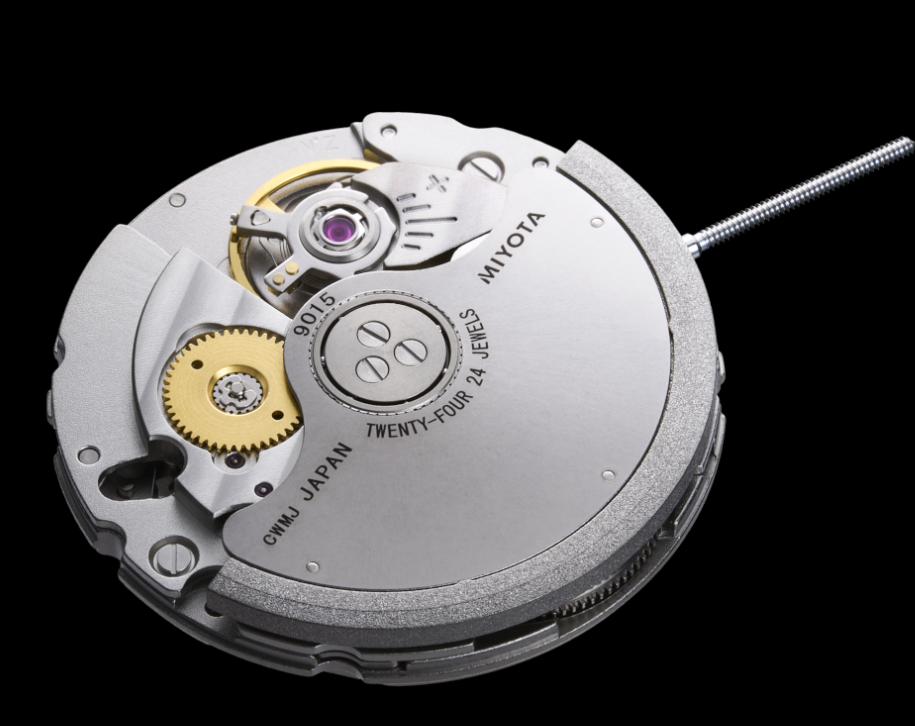
The Miyota 9015 — The One to Look For (Premium Automatic · Calibre 9015)
28,800 vph
±10–30 sec/day
3.9mm slim profile
Hacking + hand-winding
This is Miyota's best automatic movement, and it genuinely earns that status. It beats at 28,800 vibrations per hour — which gives the seconds hand a noticeably smoother sweep than lower-beat movements — and it's impressively slim at just 3.9mm, which allows watchmakers to build genuinely elegant, slender cases around it. It hacks (the seconds hand stops when you pull the crown to set the time), it hand-winds, and its accuracy is competitive with entry-level Swiss movements at a meaningfully lower price point. Microbrands who care about what goes inside their watches tend to reach for the 9015, and rightly so. It's also worth noting that if you can see through the caseback and the movement looks refined, there's a solid chance this is what you're looking at.
The Miyota 8215 — Dependable and Underrated (Standard Automatic · Calibre 8215)
21,600 vph
±20 sec/day
42hr power reserve
Date complication
The 8215 has been around since the 1970s, and there's a reason it's still in production. It's the kind of movement that simply gets on with things — reliable, easy to service, with parts available almost everywhere. It doesn't hack and it doesn't hand-wind, which some collectors will find frustrating, but for someone who wants an affordable automatic that keeps good time and doesn't give trouble, it's a thoroughly sensible choice. It's also become particularly relevant recently: the Seiko NH35, which occupied a similar position in the market at a similar price, saw its cost roughly double in early 2025 due to supply issues, making the 8215 an even more attractive option for brands working to keep their prices honest.
The Miyota 2035 — A Quiet Legend (Quartz · Calibre 2035)
±20 sec/month accuracy
Approximately £5 wholesale
Over 5 billion produced
If you want a sense of just how significant Miyota's contribution to watchmaking is, consider this: the 2035 quartz movement, launched in 1981, has had over five billion units produced as of 2024. Five billion. It costs almost nothing, keeps perfectly decent time, and runs with remarkable reliability in all conditions. There's nothing romantic about it — but then, not everything needs to be. It's become so fundamental to the watch industry that counterfeit versions exist, which might be the most backhanded compliment a movement has ever received.
The Miyota 8285 — Worth Knowing About (Day-Date Automatic · Calibre 8285)
21,600 vph
Day + Date display
42hr power reserve
This one doesn't get talked about as often, but it fills a genuine gap. If you want a day-date complication in an affordable automatic and don't want to pay Seiko's premium for their equivalent, the 8285 steps in sensibly. It's the 8215 with a day display added — no drama, no unnecessary complexity. Just a solid, reliable workhorse doing its job. Several microbrands have used it precisely because Seiko simply doesn't offer a comparable alternative at this price.

What to Be Aware Of
No movement is without its quirks, and it's worth going in with clear eyes rather than discovering these things after the fact.
The Rotor Noise on the 9015 - Worth Knowing · Not a Dealbreaker
The 9015 winds in one direction only, which means the rotor free-spins in the other — and that can produce a noticeable sound. In a thick dive case, you'll barely register it. In a slim dress watch with a lightweight case, you might hear a quiet rattle as you move your arm. It won't affect timekeeping and it's perfectly normal for this movement, but it does catch people off guard if they're not expecting it. I've seen forum threads that describe it with various levels of alarm, most of which are unwarranted. Just something to know before you buy, particularly if you're sensitive to that sort of thing.
The 8215 Lacks Hacking and Hand-Winding - A Limitation, Not a Flaw
This one comes down to what you value. Hacking — where the seconds hand stops when you pull the crown — makes synchronising your watch to a time signal quick and precise. Hand-winding means you can top up the power reserve without having to wear the watch. The 8215 offers neither. For many people wearing a watch day to day, this won't matter in the slightest. For others, it will feel like a meaningful compromise. Neither position is wrong — it's just worth knowing where you stand before you commit
When to Think Twice
My reservations about Miyota aren't really about the movements themselves — they're about how some brands choose to use them
The Pricing Problem - A Brand Issue, Not a Miyota Issue
An 8215 costs a brand somewhere in the region of £20-30 wholesale. That's a fair price for what it is, and when a brand builds an honest watch around it at an honest price, there's nothing to criticise. The problem arises when a brand stuffs a basic 8215 into a watch they're selling for several hundred pounds without being transparent about it — leaning on marketing language to imply more refinement than the movement warrants. The movement isn't the villain there. The decision to misrepresent value is. If you're spending real money on a watch, it's always worth a quick look at what's inside
Unregulated Specimens - Check Real-World Reviews
Miyota's stated accuracy figures are achievable — but they assume the movement has been properly regulated before leaving the factory. Not every brand takes the time to do this, particularly at the lower end of the market. Real-world accuracy can wander quite a bit further than the spec sheet suggests if nobody has checked. It's always worth looking for reviews that mention actual timing results rather than simply repeating the manufacturer's claimed figures — those real-world data points tell you far more.
Why It All Matters
What I've come to appreciate about Miyota is the same thing I appreciate about brands like Marloe — a kind of quiet honesty. They're not pretending to be something they're not. They make reliable movements, they've been doing it for decades, and the watch industry would look meaningfully different without them.
The 9015 in particular deserves more respect than it typically gets in collector circles. It's genuinely competitive, it enables microbrand watchmakers to build excellent watches without passing Swiss movement costs onto the customer, and it keeps excellent time. The 8215 is more limited but no less honest — a workhorse in the truest sense.
Understanding what's inside a watch doesn't diminish the experience of wearing it. If anything, it adds a layer — because you know what you're getting, why it was chosen, and whether the brand making that choice did so with integrity or convenience in mind. That knowledge changes how you shop, and usually for the better.
If you've worn a watch with a Miyota inside — or if you're considering one — I'd love to hear how you've found it. These conversations always take me somewhere interesting.


Comments